Article 363 bars the interference of courts in any disputes which may arise from certain treaties, agreements, covenants, sanad, engagements, etc., executed between a princely state and the government of India.
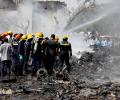
Civil Aviation Minister K Rammohan Naidu assures a clean investigation into the Air India plane crash, dismissing concerns of manipulation. The statement follows calls for a judicial probe and criticism of selective leaks from the preliminary report.

The Supreme Court has granted interim protection to journalist Abhisar Sharma in an FIR lodged against him in Assam over a video post allegedly criticising the state's policies.
The Supreme Court of India has criticized the Enforcement Directorate (ED) for focusing solely on its own fundamental rights while pursuing a money laundering case related to the Nagrik Apurti Nigam (NAN) scam in Chhattisgarh. The court questioned the agency's attempt to transfer the case to New Delhi, noting that the agency's petition under Article 32 of the Constitution is typically reserved for individuals seeking redressal for fundamental rights violations.
Commencing hearing on pleas challenging the constitutionality of the Places of Worship Act, 1991, the Supreme Court asked the Centre to reply to cross-pleas against or seeking implementation of statute.

The Congress party has accused the BJP of engaging in "damage control" after the party distanced itself from comments made by two of its MPs, Nishikant Dubey and Dinesh Sharma, criticizing the Supreme Court. Congress general secretary Jairam Ramesh stated that the BJP's clarification was merely an attempt to mitigate the damage caused by the MPs' remarks and that the party's actions were hypocritical, given the silence of the BJP president on similar comments made by other party members.
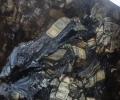
The Supreme Court of India has released an inquiry report into the alleged discovery of a large amount of cash at the residence of Delhi High Court judge Yashwant Varma. The report, which includes photos and videos, was uploaded on the court's website. Chief Justice of India Sanjiv Khanna has formed an in-house committee to investigate the matter and has asked the Delhi High Court Chief Justice to not assign any judicial work to Justice Varma. Justice Varma has denied the allegations, claiming they are part of a conspiracy to frame him. The inquiry report, submitted by the Delhi High Court Chief Justice, has been made public and calls for a deeper probe into the incident. The incident has raised concerns about judicial accountability and has prompted the Congress party to call for strong measures to uphold public trust in the judiciary.

The Supreme Court has put on hold the Uttar Pradesh government's plan to develop the Shri Banke Bihari Temple Corridor in Vrindavan, citing a lack of consultation with key stakeholders. The court questioned the state's approach and the urgency of enacting an ordinance to take over the temple's management.
The Supreme Court collegium has recommended the appointment of Karnataka High Court Chief Justice N V Anjaria, Gauhati High Court Chief Justice Vijay Bishnoi, and Bombay High Court judge Justice A S Chandurkar as judges of the Supreme Court. The five-member collegium, headed by Chief Justice B R Gavai, decided to recommend the names to fill three existing vacancies in the top court. The appointments follow the superannuation of former Chief Justice Sanjiv Khanna, and Justices Abhay S Oka and Hrishikesh Roy. The Supreme Court, which has a sanctioned strength of 34 judges, is currently working with 31 judges.
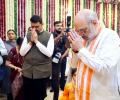
'Devendra Fadnavis is stating that Marathas must feel OBCs are not happy with reservations for the Marathas and therefore they are protesting.'
The CBI has filed a case against six Jammu and Kashmir police officials for allegedly torturing a fellow constable in custody. The case was registered following a Supreme Court order.
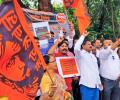
The Bombay high court on Friday constituted a three-judge special bench to hear the pleas challenging the constitutional validity of the law providing Maratha reservation following a Supreme Court directive.

AIFF top brass to meet eight ISL club CEOs on Aug 7 to discuss their concerns

Kusumavati, mother of Sowjanya, who was allegedly raped and murdered more than a decade ago, submitted a fresh complaint to the SIT probing allegations of multiple rapes, murders and burials in Dharmasthala.
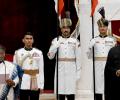
Justice Bhushan Ramkrishna Gavai was on Wednesday sworn in as the 52nd Chief Justice of India.

As the National Sports Governance Bill is set to become a law, the country's national federations and Indian Olympic Association (IOA) President P T Usha on Tuesday welcomed the landmark policy, calling it a step in the right direction as India gears up to bid for the 2036 Olympics.
The Supreme Court of India has sought responses from the Centre and others on a petition challenging the constitutional validity of certain provisions of the Waqf Act, 1995. The petition argues that the Act gives undue favor to waqf properties and deprives non-Muslims of their property rights. The court has tagged the petition with pending petitions that raise similar issues.

The bench said, given the pressing nature of the crisis, particularly in cities like Kota, Jaipur, Sikar, Vishakhapatnam, Hyderabad, and Delhi, where students migrate in large numbers, immediate interim safeguards are the call of the day.
A bench comprising Chief Justice B R Gavai and Justices Augustine George Masih and AS Chandurkar also directed that the offending video be immediately taken down and restrained the YouTube channel from republishing it or similar content.
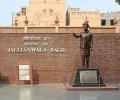
Former Supreme Court judge Justice Rohinton Nariman has warned that events similar to the Jallianwala Bagh massacre could occur if the 'basic structure' doctrine of the Constitution is diluted. In his new book, 'The Basic Structure Doctrine: Protector of Constitutional Integrity,' Nariman argues that the 1973 Kesavananda Bharati judgment, which established the doctrine, is essential for protecting fundamental rights and preventing constitutional amendments that could lead to such tragedies. Nariman's concerns are echoed by Supreme Court judge Justice K V Viswanathan, who applauds the book for its "chilling clarity" and underscores the importance of the Kesavananda Bharati ruling. The book provides a detailed analysis of the doctrine and its implications, highlighting the robustness of the Kesavananda Bharati judgment and the lack of a compelling alternative theory.
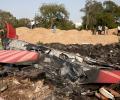
The Supreme Court has criticized the selective publication of a preliminary report on the Air India crash, calling it 'unfortunate and irresponsible'. The court raised concerns about privacy, dignity of victims' families, and the potential for biased narratives.
The bench questioned the petitioner for not moving the high court and directly coming to the apex court.

'Today, the State looks at everyone with suspicion.'
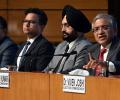
This is the third meeting of CEOs after Gyanesh Kumar took over as the chief election commissioner in February. However, Wednesday's day-long meeting assumes significance as the preparedness of a pan-India SIR are being discussed, officials said.

Chief Justice of India Justice B R Gavai on Friday praised Justice Bela M Trivedi for her career trajectory from the subordinate judiciary all the way up to the Supreme Court, where she became the eleventh woman judge to be appointed in its history.

2018-19 ISL champions Bengaluru FC said they had taken the decision "in view of the uncertainty surrounding the future of the Indian Super League season."

In a significant development, the Supreme Court on Thursday recalled its controversial May 2 verdict that had ordered liquidation of Bhushan Power & Steel Limited (BPSL) while setting aside a resolution plan of JSW Steel Limited for the ailing firm. A bench comprising Chief Justice B R Gavai and Justice Satish Chandra Sharma observed that the May 2 judgment, authored by Justice Bela M Trivedi, since retired, did not "correctly consider the legal position as has been laid down in the catena of judgments".
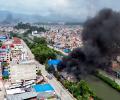
'9 September saw Kathmandu and other key cities under the control of goons.' 'There was no authority, the police was nowhere.' 'The crowds torched all three centres of the state -- the supreme court, parliament and the Singha Durbar government headquarters.' 'The army stayed aloof from the complete destruction of these edifices, which is less than a kilometre from its headquarters.'
The Supreme Court has agreed to hear the anticipatory bail plea of a cartoonist accused of uploading objectionable cartoons of Prime Minister Narendra Modi and RSS workers on social media. The Madhya Pradesh High Court had previously refused to grant him relief, observing it was a gross misuse of freedom of speech.
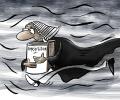
'After each election the losers troop to the court with various objections. The general election will not be different.' 'It could be worse if there is no clear majority and the President has to invite the party with the largest number to form the government,' points out M J Antony.
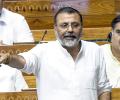
Fourth-term Bharatiya Janata Party MP Nishikant Dubey, one of the more vocal party members in the Lok Sabha, launched a broadside against the Supreme Court on Saturday, saying Parliament and state assemblies should be closed down if the apex court has to make the laws.

The Juvenile Justice Board on Tuesday said the 17-year-old boy accused of driving a Porsche car in an inebriated state and mowing down two persons last year in Pune will be tried as a juvenile.
The statement was signed by 15 former judges, 77 ex-all India services officers and 25 veterans.

Chief Justice of India Sanjiv Khanna has recommended the impeachment of Allahabad High Court judge Yashwant Varma following an investigation into a cash discovery incident at his residence. The recommendation follows a report by a Supreme Court-appointed committee that confirmed allegations of cash discovery against Justice Varma. The CJI's recommendation is based on the established in-house procedure for dealing with allegations against judges of constitutional courts.

Amidst ongoing tensions with the ruling DMK government, Tamil Nadu Governor R N Ravi has invited Vice President Jagdeep Dhankar to inaugurate a meeting of state university Vice Chancellors in the Nilgiris district, sparking criticism from political parties, particularly the Left, who have urged a boycott. The meeting comes in the wake of the Supreme Court ruling in favor of the Tamil Nadu government regarding the appointment of Vice Chancellors, which has stripped the Governor of his previous authority as Chancellor. The Governor, however, maintains his right to convene the meeting, highlighting the ongoing power struggle between the Governor and the state government. The meeting is scheduled for April 25 and 26.
The Election Commission of India is preparing for a nationwide special intensive revision (SIR) of electoral rolls, following a Supreme Court ruling. This move aims to update voter lists and address concerns about illegal migrants.

'Has the Supreme Court ever said that the Preamble is the basic structure of the Constitution?'

The committee said the Uttar Pradesh government did not file appeals against the high court's November 8, 2023 order and instead, an impleadment application was filed in the pending plea before the top court.

The Supreme Court has expressed concerns over student suicides at IIT Kharagpur and Sharda University, directing expedited investigations into the incidents. The court questioned the institutions' handling of mental health issues and compliance with previous directives.
The Supreme Court on Monday referred to a five-judge Constitution bench a suit filed by the Kerala government raising the issue of ceiling on net borrowing.
